
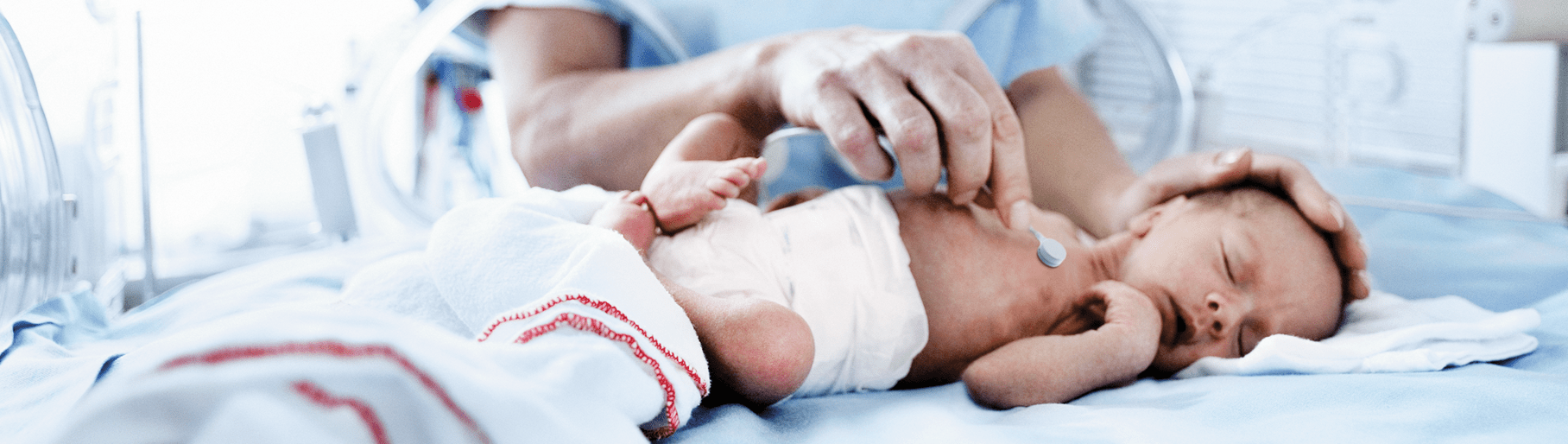
Arkansas Children's Hospital is the only Children’s Hospital in Arkansas, and one of the largest and most respected facilities serving children in the United States. This private, non-profit healthcare institution boasts an internationally renowned reputation for achieving medical breakthroughs and intensive treatments, unique surgical procedures and forwardthinking medical research.
Complications and morbidities resulting from fluctuating tcpCO2 values are an ongoing concern when treating infants in neonatal intensive care units. For specialists in these units, the focus today has changed from mere survival for these patients to survival without complications.
At Arkansas Children’s Hospital, clinical research in neonatology falls under the direction of Dr. Sherry E. Courtney. "The challenge we face is that we have no other way of continuously trending pCO2 in infants other than transcutaneous monitoring," states Dr. Courtney. "Without it, we have to do sporadic blood gases, which are of limited use since they focus on only a snapshot of the infant's condition. pCO2 can potentially change constantly in the critically ill, ventilatordependent infant."
Dr. Courtney goes on to say, "It’s critical that we have transcutaneous monitoring because we’ve learned that very high or low pCO2 levels can be extremely dangerous to an infant’s brain. In addition, low pCO2 levels indicate over-ventilation, which can be damaging to the lungs."
Clinical studies within the past several years have more fully elucidated the influence of pCO2 on organ function and damage. Literature has also demonstrated
how continuous pCO2 monitoring can help quickly diagnose significant respiratory problems such as development of a pneumothorax.
"The problem you face is that babies don’t change in appearance when their pCO2 level changes," reports Dr. Courtney. "If a baby has a chance of permanent brain damage because his pCO2 is very low, you absolutely want to know right away so immediate action can be taken."
Dr. Courtney further states, "There are actually several treatment circumstances, such as with the use of high-frequency ventilation, where pCO2 levels can drop quite low in only a matter of minutes. This is yet another reason why transcutaneous monitoring is a must."
Another danger of monitoring pCO2 levels only sporadically occurs when levels are found to be too low or too high. For example, if a baby is on a high-frequency oscillator without a transcutaneous monitor and a low pCO2 level is detected through blood gases, a common course of action may be to over- or under-adjust the oscillator amplitude. This can lead to pCO2 levels that are either still too low, or much too high, when gases are checked again an hour or more later.
Literature has shown that wide fluctuations in pCO2 may have a greater association with brain damage for infants than continual high or low values alone. By utilizing transcutaneous monitoring, clinicians have an easier time responding to changes in pCO2 readings in a timesensitive manner, thus minimizing negative events.
Although pulse oximetry has largely replaced transcutaneous oxygen monitoring, the ability to accurately measure tcpO2 using lower temperatures to heat the sensor may result in increased utility of tcpO2 monitoring in preterm infants at risk for retinopathy of prematurity and bronchopulmonary dysplasia. Future applications may include monitoring pre- and post-ductal tcpO2 levels in infants with persistent pulmonary hypertension.
Dr. Courtney summarizes her feelings as to why transcutaneous monitoring is vital to providing appropriate ventilator care to infants by saying, "It all comes down to the simple fact that transcutaneous monitoring allows for continuous pCO2 readings, which enable clinicians to intervene at the appropriate moment to prevent infant complications and morbidities."